- Court Street Data
- Posts
- If You Build It, Deals Will Come
If You Build It, Deals Will Come
The role of data in building an enterprise sales motion.

William DeCesare
December 18, 2025

Selling is a high-touch, highly personalized, and often difficult process. You have to:
Uncover your prospects’ problems. Peel back layers of the onion with questions, but not so much so that it turns into an interview.
Understand your prospects’ market. Research their product and/or service to understand their business model as much as they do.
Understand your market. Know the players and demonstrate how and why your product is uniquely fit to solve your prospects’ problems.
Communicate at the right cadence. Continually follow up, but be careful not to cross the fine line between a gentle nudge and an annoying pester.
And that’s assuming the sales engine already exists.
Building a sales motion from scratch? Even harder. It’s defining how to position your offering, often with incomplete information and a lot of guesswork, in addition to the actual selling.
In practice, that means:
Discovering your ideal customer profile (ICP). Run experiments to understand the types of decision-makers, teams, and organizations best suited for your product.
Curating a playbook for your ICP. For example, nuances in outbound email scripts for small and medium-sized businesses vs. mid-market businesses, or multi-threading decision-makers after the initial introduction.1
Training your team on the playbook. Conduct formal training sessions, pipeline reviews, and adherence monitoring until your team is up to speed. Remind them to provide consistent feedback, especially if things turn south, because the playbook is always a “working version.”
Instrumenting CRM workflows. Ensure the correct information is pushed to the right people at the right time. Build dynamic tasks like lead scoring, contract review, and deal stage progression.
Even with a well-defined plan, issues with data quality, system integration, and end-user aptitude will exacerbate your difficulties in building a sales motion.
What better way to illustrate this than a hands-on example?
Scenario
Earlier this year, Court Street Data partnered with dot.cards, a hybrid eCommerce/SaaS business in the digital networking space. Dot pairs a tangible hardware product, such as a digital business card or wristband, with an attached SaaS offering for upgraded networking capabilities.
While the business initially distributed its products via a B2C model and employed standard eCommerce (digital ad spend) and SaaS (PLG) selling practices, it was poised for a powerful B2B offering and sought to grow the business upmarket through enterprise partnerships.
Court Street Data partnered with dot to accomplish a simple objective:
Users, Customers, and Companies Source of Truth. Build a unified view of users, customers, and companies in BigQuery based on backend application data, Shopify events, and Segment event tracking.
Sales Enablement. Enable account executives to optimize upsell prospecting efforts by sending relevant company attribute information to Salesforce.
In practice, “simple” was a bit of an overstatement.
Building unified entities depends on stakeholder input. How would we address edge cases, such as users with purchases on different email addresses on Shopify? How would we address data quality issues, such as multiple user IDs across the app backend, BigQuery, Segment, Mixpanel, and Salesforce? Which tools need to be implemented to support these efforts while stabilizing data governance?
Furthermore, sales enablement, particularly when a sales motion is less defined, involves testing the significance of high-value attributes and educating stakeholders on the results. Questions like the following came to mind: Which attributes move the needle in sales discussions? How can we test and learn this? How equipped are the account executives to use analytics and reporting tools?
Solution
It’s challenging to distill months-long work into a few paragraphs, but here we go 🚀
Audit Upstream Event Tracking
We began by auditing events across the application and eCommerce platform (i.e., Shopify). This involved testing different Shopify checkout flows, app functions, and lifecycle management flows to validate accurate event tracking and event parameter information.
Building a single source of truth across users and customers typically requires a single “person” identifier. As a result, we assessed whether user and customer engagement could be stitched into a single warehouse row given dot’s existing Segment setup.
After the audit, we delivered an updated event tracking plan for dot’s engineering team, a roadmap for unifying user ID across all apps within dot’s ecosystem, and a proposed DAG to power the entity modeling.
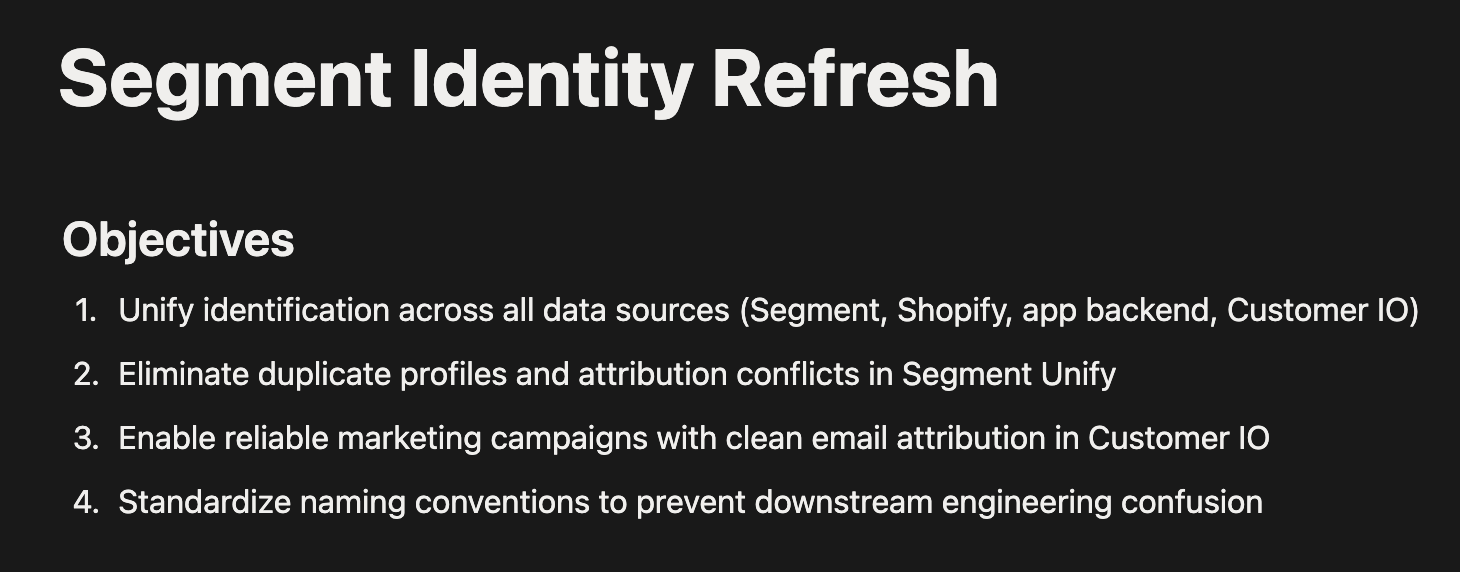
Excerpt from the Segment Identity audit.

The proposed DAG.
Build a Unified View of Users, Customers, and Companies
As any data practitioner knows, the ability to leverage fresh data and version control your work is important for continuous success. However, there’s merit to the practice of starting small, validating, and iterating.
In dot’s case, we quickly matured from one-off queries → scheduled queries in BigQuery → running models in dbt. Writing the initial data models as queries in BigQuery enabled quick changes while still realizing results. Once the team felt comfortable with the data model decisions made and we received actionable feedback after use, we codified models in dbt.

A simplified version of the final DAG.
Enable Accessibility via Business Intelligence and Additional Tooling
We started by providing dot’s sales team with access to basic BI tool reporting. This allowed for rapid experimentation, introducing all possible attributes to the team. Want to see users who most recently signed up? Let’s do it. Users with standardized seniority of VP and above? Sure thing.
We quickly realized that more advanced functionality was needed, as account executives were manually squeezing BI tool exports to fit the schema of the Salesforce Leads object, requiring hours of ETL in Google Sheets.2 They had begun testing their own hypotheses, such as receiving a higher outbound response rate from senior prospects, and we wanted to support this endeavor by building a tool that made creating lead lists as easy as possible.
The result: a custom Retool application that queries the warehouse with specific parameters, adds selected rows to a list, and exports a finalized lead list that fits the Leads schema.

Salesforce lead creation in action 🔥
Future State: Dynamic Lead Creation
The future state of this workflow will be a system that dynamically creates leads as free users sign up to dot’s application. Prior work, such as asking questions like “what criteria determines a lead in this segment?” and “how can we validate the success of these dynamic leads?” will inform the dynamic lead creation criteria.

A potential infrastructure for dynamic lead creation.
While there will likely always be a need for account executives to push leads into the CRM, we aim to streamline this process as much as possible, with 90%+ leads created from tried and true criteria.
Impact
Dot’s sales team is now:
Quickly identifying the strongest leads for outbound and seamlessly pushing these leads to Salesforce for tracking.
Closing deals that are rapidly approaching six-figures in size and with potential for upsell.
Understanding the value of data in their sales motion.

💰💰💰
Learnings
Context is Key
Developing context is key to a successful outcome in any data project. Particularly in this case, having a uniquely compact understanding of dot’s product, market, and organizational structure. One benefit of living in a world with tech-forward GTM teams: you can develop sales context without joining sales calls. Most sales teams leverage a sales call transcriber (Gong, for example), where you can summarize learnings with AI, listen to recordings, and collect information that informs your data product.
Empower Your Sales Leader
Our typical guidance is to ensure that we adhere to data governance best practices in everything we touch. However, starting a sales motion is like developing a new product: experimentation and speed are key. If this means manually creating segmented lead lists based on warehouse analytics, so be it. There will be time to build in efficiencies, structure, and governance after validating the use case.
Closing Thoughts
Building a sales motion is hard.
A strong data foundation is crucial to a successful and scalable sales motion.
Enable your team to cook, as the kids say.
1 According to Gemini (the hottest AI right now): “Multi-threading in sales is a B2B strategy where sellers engage multiple stakeholders (decision-makers, influencers, users) within a single client account from different angles, using tailored messaging to build consensus, reduce deal risk, and accelerate closing complex, large deals by creating champions across various departments and roles.”
2 AKA any data practitioner’s hellscape.
Reply